Ocean Weeps Blue: Chasing the Blue Tears of Double Moon Bay

“Stand at the water’s edge on a moonless night at Double Moon Bay, and the sea appears to cry — each breaking wave releasing a cascade of cold, electric blue light. The locals call it the blue tears.”
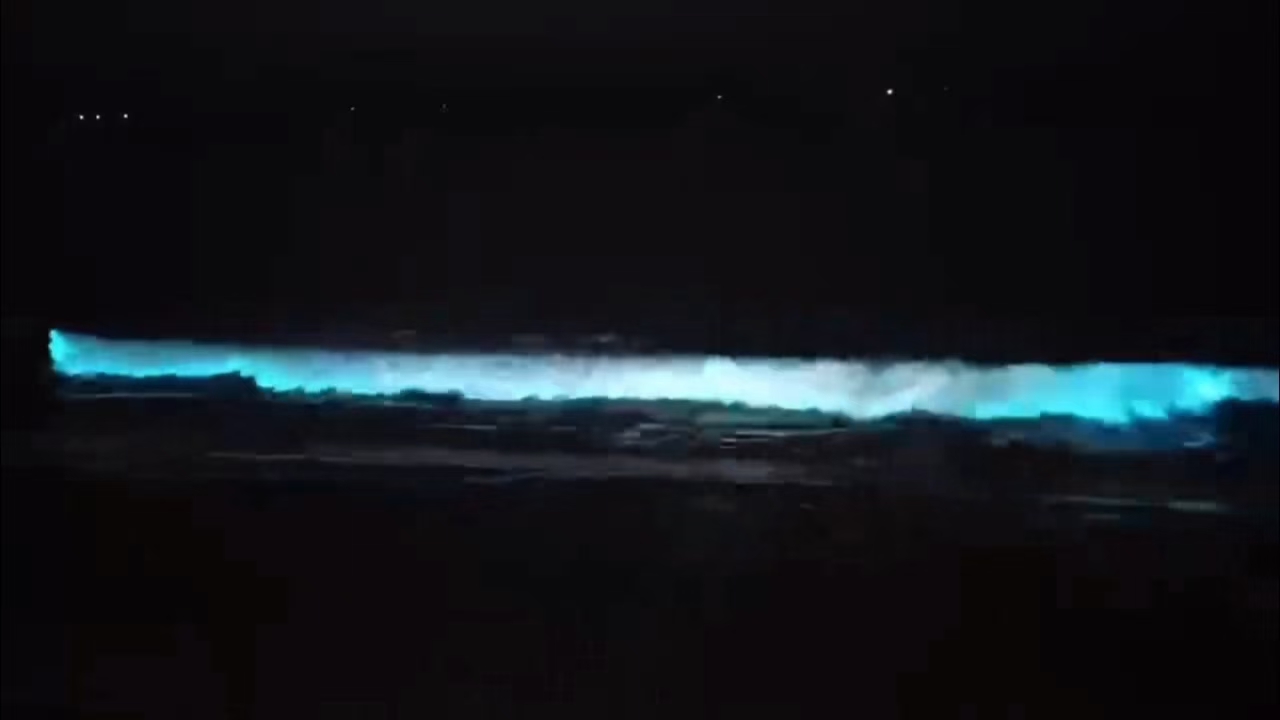
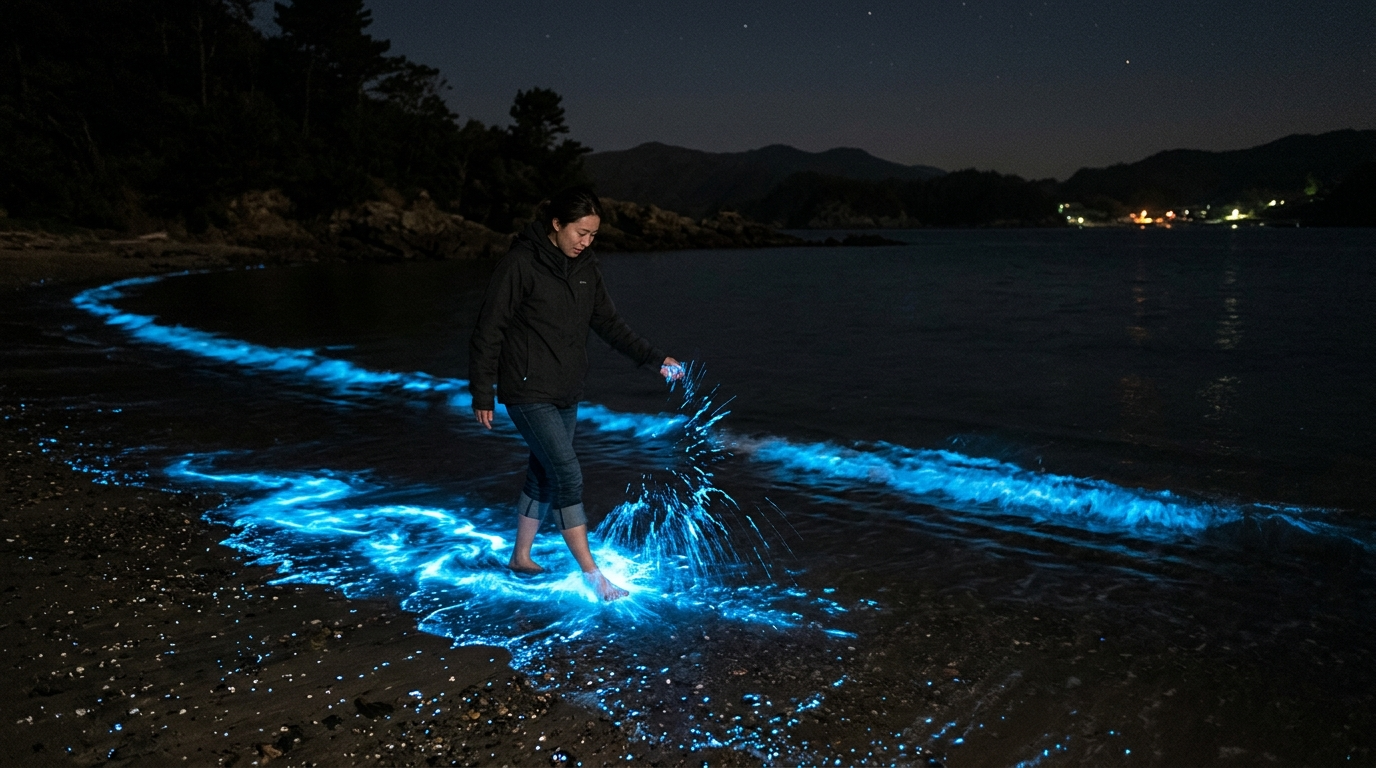
The first time you see the blue tears, you’re not ready for it. You’ve read the description, maybe seen a photo, told yourself you know what to expect — and then a wave breaks against the rocks and the water ignites, cold and electric, and whatever you had imagined turns out to be inadequate. At Double Moon Bay, Shuangyue Bay in Guangdong Province, this happens every summer between April and August, when the South China Sea blooms with bioluminescent organisms and the shoreline stops looking like it belongs to the real world.
What doesn’t get said often enough is why it happens here specifically. The blue tears need clean water, dark skies, and a coast that hasn’t been built over or lit up. Double Moon Bay still has all three — and that, more than anything, is the story worth telling.
Blue Tears Meaning?
The organism behind all of this is Noctiluca scintillans — a single-celled creature, barely visible to the naked eye, that drifts through coastal waters across much of the world. It goes by “sea sparkle” in English, which is accurate but undersells it. Inside each cell is a chemical that reacts to physical disturbance, releasing a flash of blue light. A wave, a hand, a foot, a thrown stone — anything that moves the water is enough. Alone, one organism produces nothing you’d notice. Get a few million of them together in a warm bay and the whole surface starts firing.
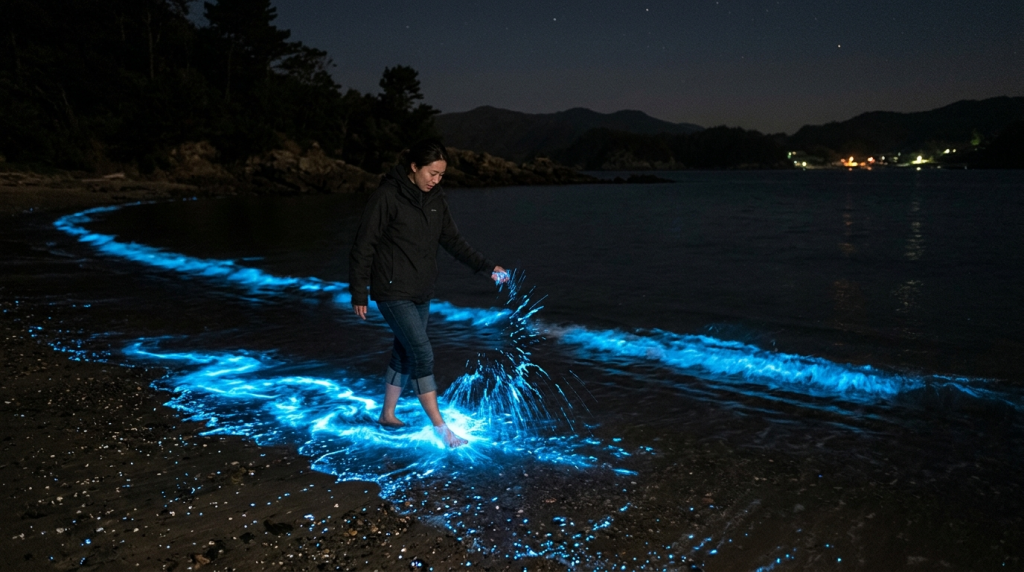
The blooms at Double Moon Bay tend to peak between April and August, when sea temperatures climb and conditions along this stretch of the Guangdong coast align. Nights with little or no moon are when it really shows — the darker the sky, the more the water seems to generate its own light from below. There’s no schedule, no guarantee. Some nights nothing happens. Others, the entire shoreline glows.
A Bay That Earns Its Beauty
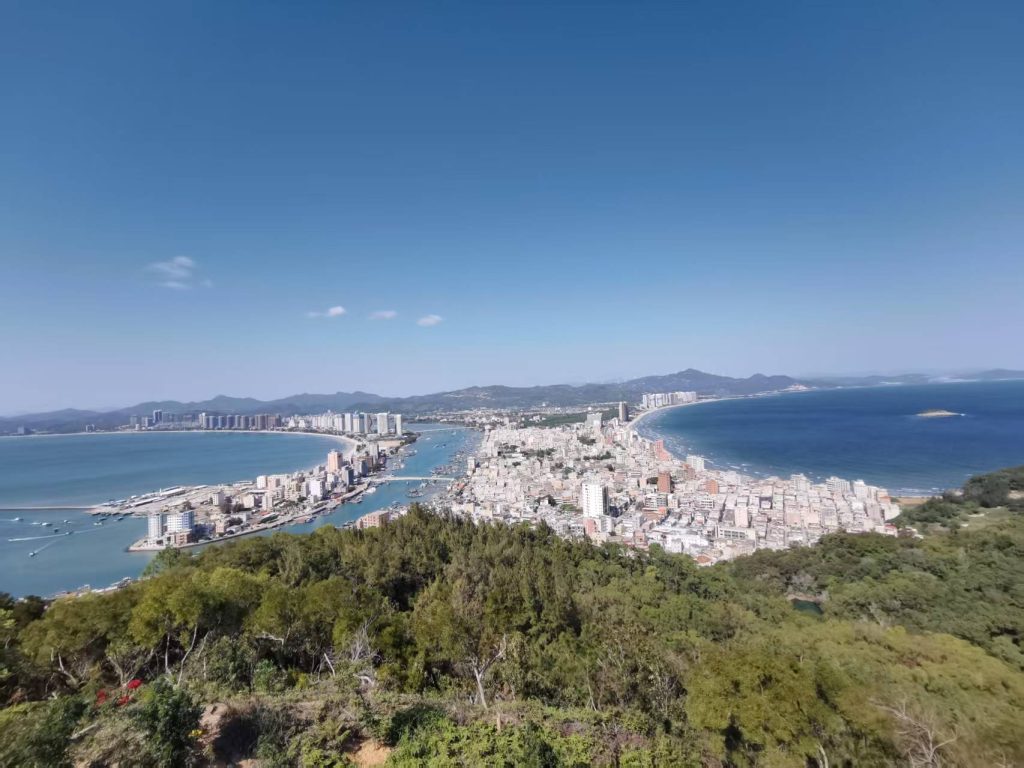
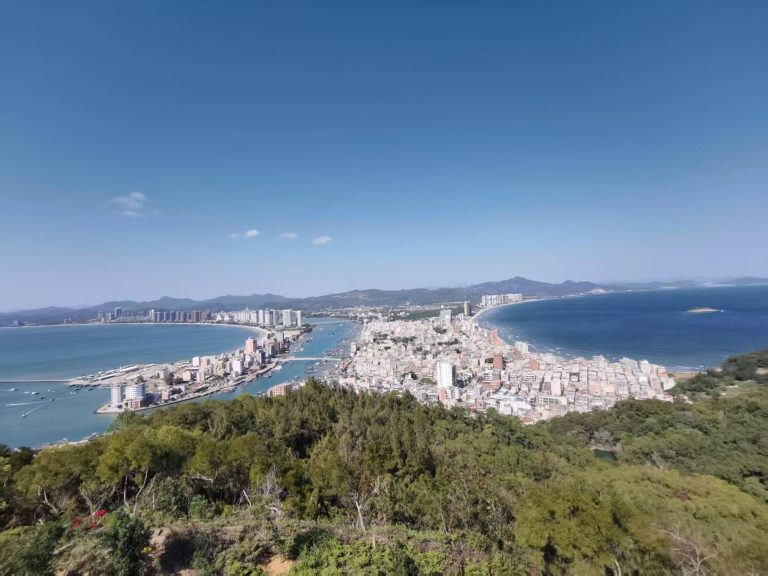
Shuangyue means double moon. Stand on the right hill and you can see why — two curved bays sitting side by side, the coastline bending in a way that looks almost deliberate. It’s at the bottom of the Renping Peninsula in Huidong County, roughly two hours from Shenzhen by car, and the drive in is the first sign that you’re leaving the city behind properly.
There’s no port here, no industrial strip along the waterfront. The hills above the beach are still forested. Under the water, Sargassum and sea lettuce grow in thick patches off the rocks — the kind of thing that disappears fast when a coastline starts to degrade. The temperature stays warm most of the year and the bay gets strong light, which means the marine life is dense and the water, on most days, is clear enough to see the bottom.
Locals call it the Maldives of Huizhou. It’s not quite that, but the water quality is genuinely unusual for this stretch of coast. And water quality is exactly what determines whether the blue tears show up or not. The organisms that produce the glow don’t tolerate pollution or artificial light — they need clean, dark, warm water, which is a description of Double Moon Bay on a good night. The scenery by day and the light show after dark are products of the same conditions.
What Else to Expect at Double Moon Bay
The blue tears may be the headline act, but Double Moon Bay rewards those who linger.The snorkelling is genuinely good – clear water, rocky reefs, sea anemones, kelp. The kind of underwater environment that takes years of clean water to build.
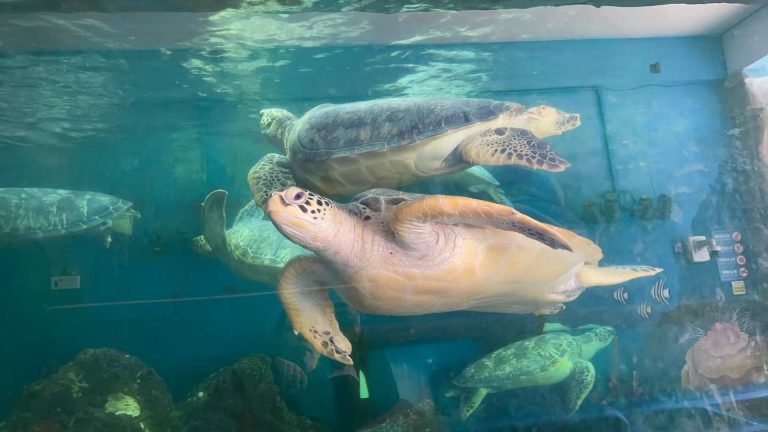
A few kilometres along the coast, the Guangdong Huidong Sea Turtle National Nature Reserve is the only place left on mainland China’s entire coastline where green sea turtles still nest. Fourteen sites existed here in the 1980s. This is the one that made it. Since 1985 the reserve has released over 60,000 turtles back into the South China Sea.
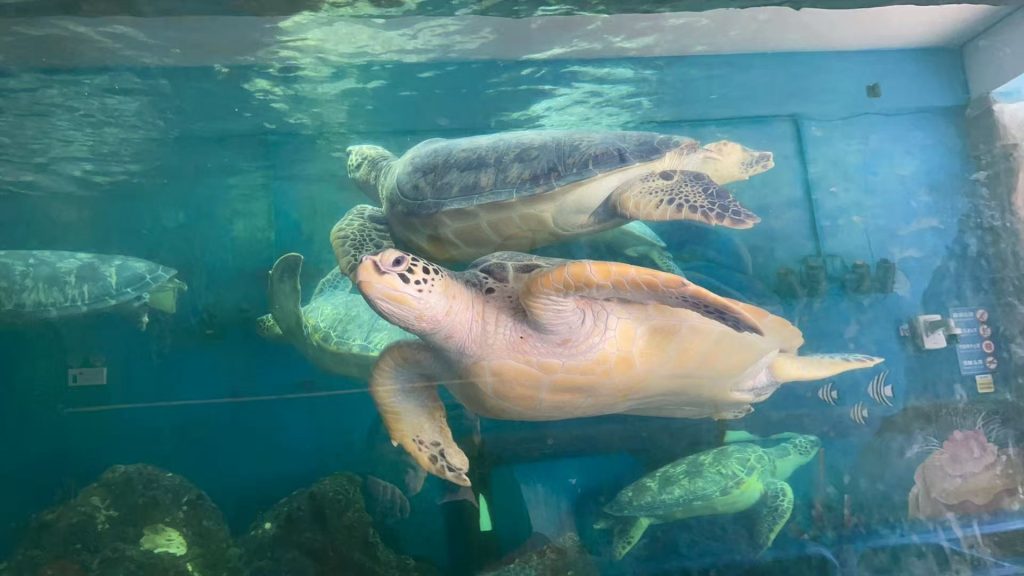
Nesting season runs May through October. The reserve runs supervised evening sessions – you watch a female turtle come up the beach, dig her nest, lay her eggs, and disappear back into the water. No commentary needed.
How to See the Blue Tears?
The window is April to August, but June and July are when things get serious. Don’t plan for an early night — the blue tears show up somewhere between 8 pm and 2 am, and there’s no predicting exactly when. A clear sky helps, a southerly breeze helps more. After a rainy day that suddenly clears, or on a night with no moon at all, the bay can go electric. Before heading out, search for Double Moon Bay blue tears groups on WeChat — locals post live updates, and it beats standing on a dark beach for three hours with nothing to show for it.
Three spots worth knowing. Vanke Shuangyue Bay Beach is the easiest option — wide open shoreline, town a short walk behind you, good for a long wait with regular food-and-warmth breaks. Sea Turtle Bay has noticeably cleaner water than most of the coast, and the blooms reflect that; if the daytime plan already includes the turtle base, it makes sense to stick around. Lover’s Dam is the one people remember. It’s a narrow stone breakwater jutting into open sea, and when a wave hits the rocks at your feet and explodes blue, the effect is immediate and total. No railing between you and it.
For the camera: skip phone mode entirely. A tripod is non-negotiable. Somewhere around ISO 2000, f/2.8, and a 10 to 20-second exposure is a reasonable starting point — adjust from there depending on how active the waves are. Torch is useful for the walk, useless pointed at the water; shine it on the sea and the organisms shut off. Throw a jacket in the bag even in summer, because the bay after midnight is not the bay at sunset. Same goes for mosquito repellent — they’re worse near the reserve.
From Shenzhen, two hours by car. From Huizhou city centre, ninety minutes. Weekends in July fill up faster than most people expect, so book the room first.
Blue Tears: China vs. Malaysia
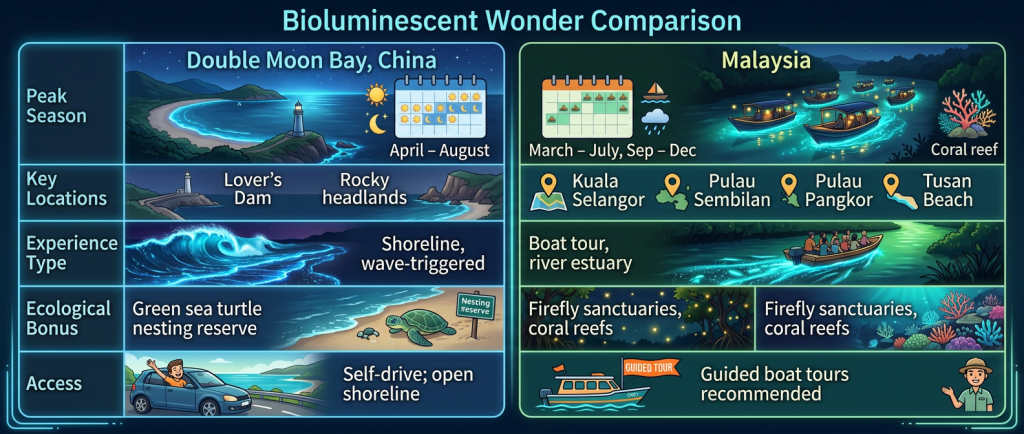
Malaysia has blue tears too. Kuala Selangor, Pulau Sembilan, Pulau Pangkor — sightings run March to July and again September to December, a longer window than Double Moon Bay thanks to the equatorial climate staying warm year-round.
The experience is different though. At Double Moon Bay you’re on the rocks or the sand, waves breaking at your feet. At Kuala Selangor you’re on a boat, drifting through the estuary where the Selangor River meets the Straits of Malacca, using a long pole to swirl the water and watch the light trail behind it. More controlled, more intimate.
China’s blooms tend to be larger and more intense — whole stretches of surf firing at once. Malaysia’s are quieter, softer. Neither is wrong. It depends on whether you want to be in the middle of it or moving through it slowly.
References
- American Geophysical Union (AGU) – China’s sparkling bioluminescent seas are glowing brighter
- Our China Story – “Blue tears” bloom: 3 best spots you can’t miss in GBA cities
- Baidu Baike – Double-Moon Bay
- GDToday – Against the current: rescuing green sea turtle and Chinese bahaba in Huizhou’s Double Moon Bay. .
- Hype Malaysia – 7 Locations In Malaysia Where You Can Find Blue Tears